Time: The Daily Stretch to See it Anew

“Time is relative; its only worth depends upon what we do as it is passing.”

Albert Einstein

When you become immobilized in making a decision about how to spend your 1.5 hours of “free” time while your child is napping.

When it feels impossible to transition between the seemingly endless “to do’s” and resting because a voice deep inside you is screaming that you may not have “enough” time to get your “to do’s” accomplished later.

When you call the doctors office at the last minute to apologize that you’ll be running 10-15 minutes late due to traffic, but really you just couldn’t stop cleaning up the kitchen or getting in one last load of laundry before you left (referencing back to scenario 2).

The daily fight with time has been something I’ve reckoned with for what feels like forever. But when I was recently asked by a coach to think about when I first became aware of time as an oppressive phenomenon, I froze. I couldn’t remember when the plague of “time scarcity” began. Perhaps it was in college, when I found myself for the first time, living on my own and making decisions apart from my parents about how to structure and manage large blocks of time. I do remember feeling uptight about assignment deadlines and the like but when I look back on those years, it feels like time was never-ending. The days would last well into the evening, going to sleep for 2am was not uncommon and sleeping to 10am for an 11am class was the norm. No, it wasn’t then. Time flowed like honey and there was always more to be found.

I do have a distinct and sticky memory of becoming aware that time was a construct when I studied abroad in Senegal my junior year of college. I remember when one of my Senegalese professors with whom I became close, shared that in Senegal (and across Africa) there was a completely different rationalization given when people were “running late.” He explained that when a friend or colleague was “late,” it was natural to assume they were intercepted by something that was important and necessitated them taking more time. If a person was late, for example, for a rendez-vous with friends, you might assume that a sick family member needed them. In other words, you naturally gave people grace and a built in buffer. NOTHING started on time and everyone gave one another the benefit of the doubt.

More than 20 years later and with the advent of smart phones, I can’t help but wonder if the oppressiveness of “white supremacy culture” in our country has seeped in and made it that much harder to let go of a constant sense of urgency.

People have been working and raising families for millennium. How has technology become so all-encompassing and resulted in us being more tethered to time than ever before?

An irony is that I stopped wearing a watch years ago. I rely on my cell phone to monitor the day and time for me now. We have and own more things than ever before, and yet time feels scarcer than ever before.

As a “newer” parent, I’ve noticed just how many references to time fall into our vernacular when talking to our children…

“Running late,” “must be on time,” “wasting time,” “time is ticking,” “we can’t be late,” “on time is late,” “respect my time,” “time is precious.” When I catch myself using time vernacular in these contexts I try to divert myself and say something different. “It looks like you need some help before we go, let’s keep moving, or we need you to participate.” It’s fascinating and sad in a way that we superimpose our construct of time on children, who are blessed (we hope) with not needing to be fully aware of it (yet).

I remember picking up the book, Einstein’s Dreams (Alan Lightman) in my early 20’s and my mind being blown away. Lightman imagines dreams that Einstein might have had in 1905 when he was dreaming up his theory of relativity. Each dream portrays a world in which time works differently. In one world, for example, time is circular and people repeat their highs and lows over and over (not too dissimilar from the concept presented in the movie Groundhog Day, which also fascinated me at the time). In other worlds, time moves backwards and people’s journeys unfold in reverse order. This journey is also fleshed out in movie form in the film, The Curious Case of Benjamin Button. I was equally fascinated by this story and have found my mind wandering back to it over the years.

In the end, I wonder if the way we relate to time is relative to our human complex with mortality. After all, time is finite. Our days are numbered, and even if we are Benjamin Button, getting younger with time, we eventually become absorbed back into the universe. The material things we surround ourselves with, the busyness we become immersed in…might all of this be an illusion and a distraction from our fear of the inevitable?

The many colloquial expressions about time are steeped in truth. Time does move faster as we get older. Not literally, but relative to our spirits. We are more consumed with responsibility, and our bodies forget or become disillusioned with the present, even to the point of becoming disembodied. How can we fight back against this, so that we don’t blink and find ourselves looking back at years of “wasted time?”

Perhaps one helpful concept which flips time on its head is Shabbat, the Jewish day of rest. It occurs each week from sunset on Friday through sunset on Saturday, and is celebrated by Jewish communities around the world. I remember starting to incorporate it into my life spiritually and therapeutically as a graduate student. Living in Washington, DC, and swimming in a culture of political and professional networking mania, time became all-consuming. I remember finding it particularly challenging to “turn off.” I felt pressure to always be “on” or working. As part of my therapy, I began instituting certain boundaries for myself on Shabbat. Over the years, this concept has become trendy. The idea of a “technology shabbat” has been coined, but for me, it has been a lifeline to sanity.

I’ve experimented over the years with observing a form of Shabbat, from shutting down my phone to not allowing myself to check email or be on any screen. I find it is a welcome respite from the noise of the week. In fact the only day I often give myself permission to slow down enough to write creatively has been Shabbat.

How can I give myself permission to incorporate a “tech Shabbat” on other days and in other moments of the week? In the hybrid world of work we now live in, it has become even harder to create these boundaries. Access to “work” can literally be in your pocket or in your ear bud at any point in the day or night. We must reset our own priorities as no one else will do it for us.

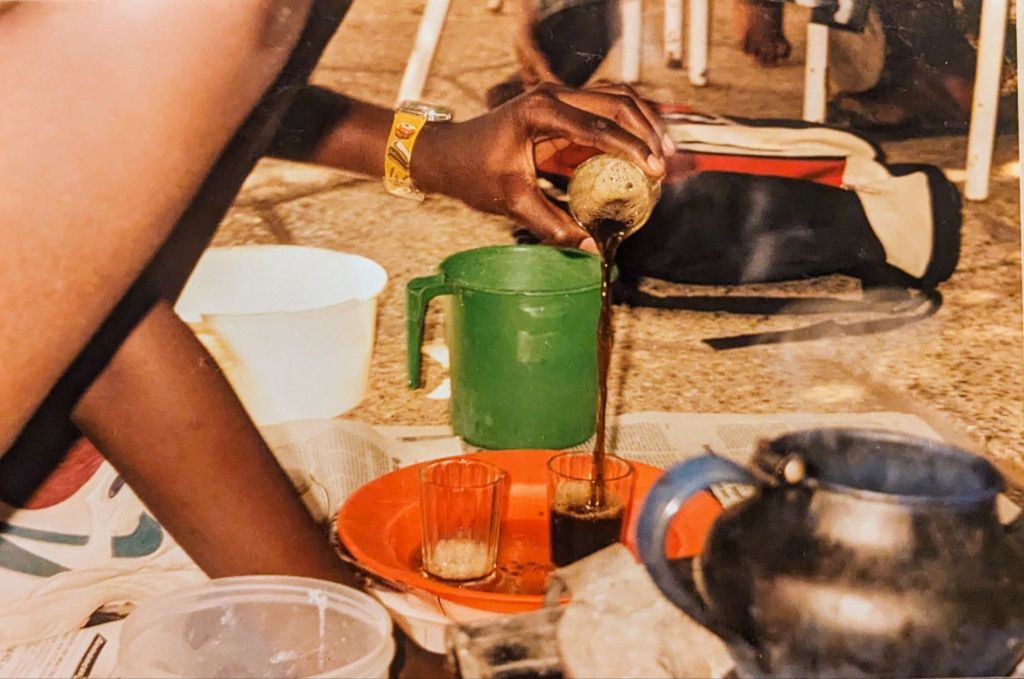
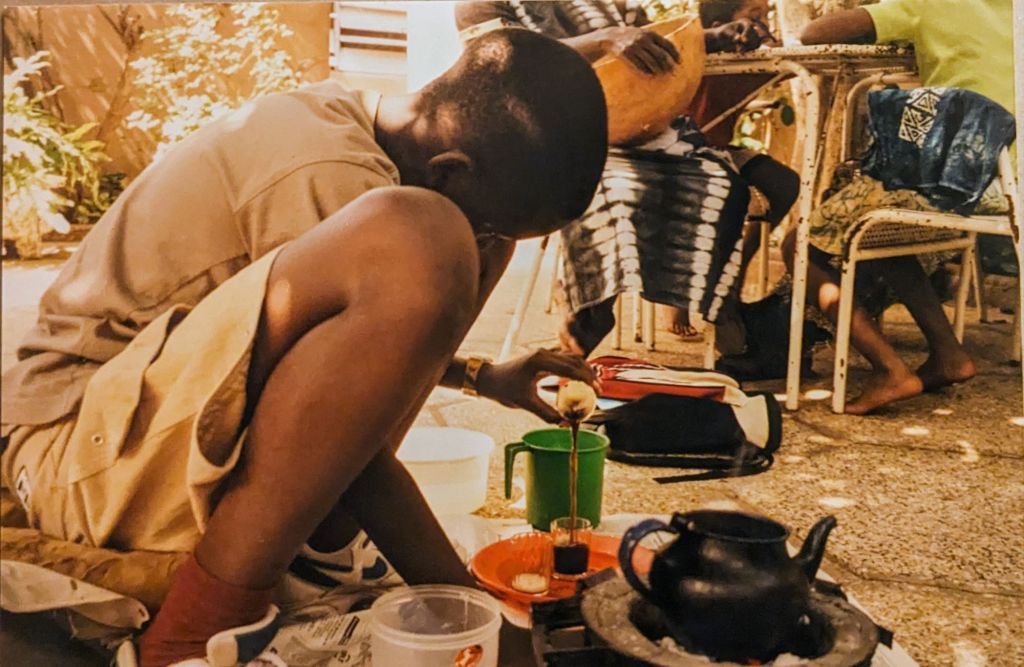
I’d like to close with the concept of “Ataya” or the three-cup ceremonial tea drinking tradition I learned about in Senegal. Ataya, which in Wolof translates to the “preparation of tea,” is an integral part of Senegalese culture. “Each cup represents the growth of friendships or the stages of life. The longer you wait for your Ataya, the stronger and sweeter friendships grow.” Whether it’s the start of a family visit or a business meeting, or even rounding a street corner on your way to the market, you can always find someone making Ataya.

Slowly, over the course of the six months I lived in Senegal, my body and spirit acclimated to slowing down and engaging in this ritual. Often sitting on cushions, friends and peers gather around a tray of small glass cups and boiling water, waiting for the tea leaves, mint and sugar to simmer. The act of pouring the tea back and forth, from cup to cup, slowly building and creating a foam lather, is a form of meditation in and of itself. You finish your tea when…you finish. Time isn’t in control. Instead, it is the tea and sweet moments of connection that call the shots.

My eyes flutter open after taking a short nap while my daughter sleeps. I take a deep breath and sigh. It is Shabbat again and I’ve given myself permission to rest and write. A sweet gift that I don’t think I will ever take for granted again since becoming a parent. I know the laundry waits. Emails are likely piling up. And I’ve got a list of errands to run and people to call back. But for right now, I will practice surrendering my time to the universe and being grateful for the early spring trees outside my window, slowly swaying in the cool wind.

The highest version of myself comes out in these moments. Her voice is quiet but I can feel her trying to speak. She’s saying, “shhh, quiet down now, just be sweet girl, resist the urge to move and do and accomplish. Your life awaits in the present moment. You have my permission to play.”

“The world has our hands, but our soul belongs to Someone Else. Six days a week we seek to dominate the world, on the seventh day we try to dominate the self.”

Rabbi Abraham Joshua Heschel
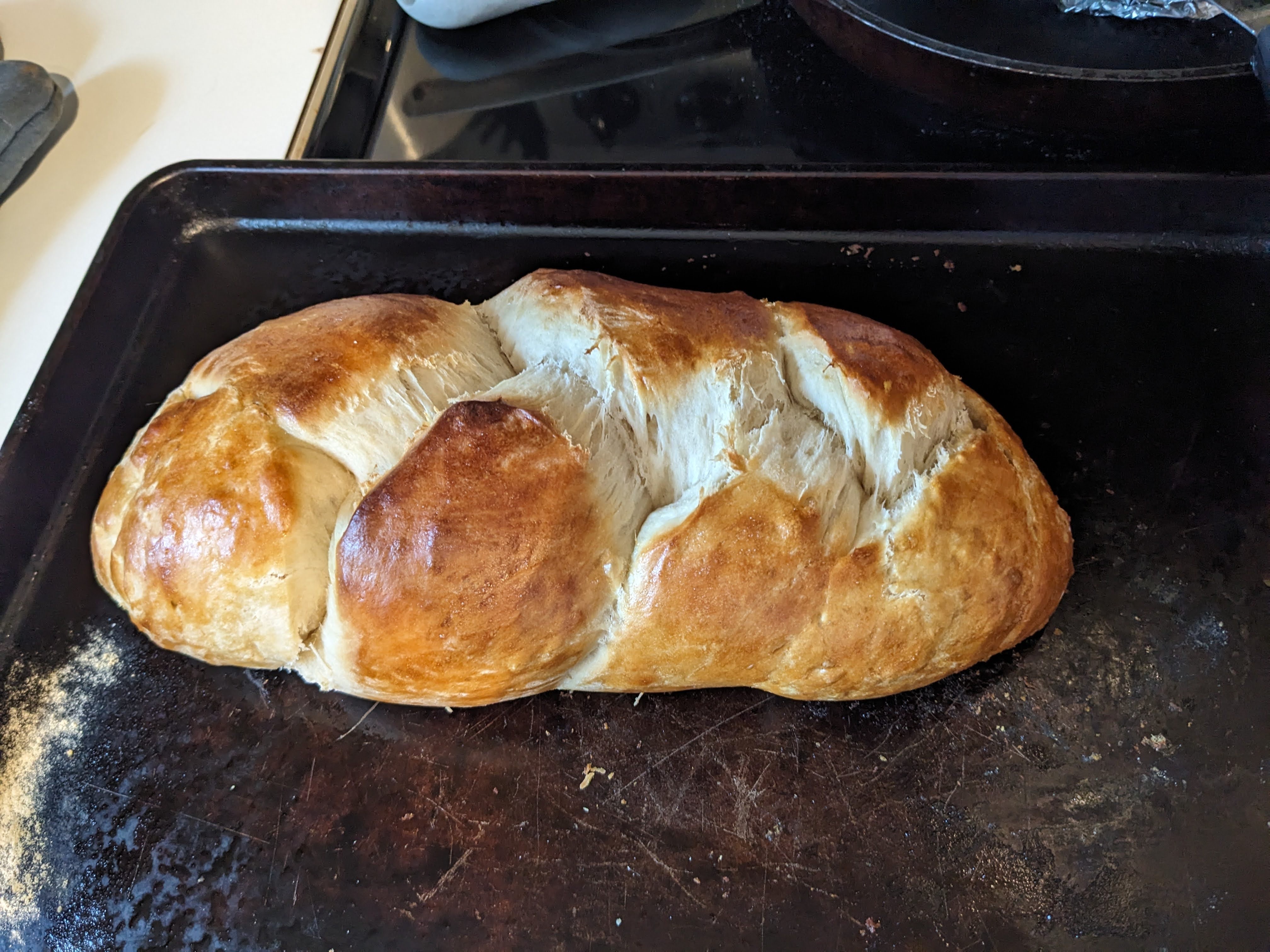
Homemade Shabbat Challah

Brandi Land

“In the cradle of the circle.
All the ones who came before you.
Their strength is yours now.
You’re not alone.”

Allison Russell

Would you believe me if I told you thousands of people, mostly women, converge on a resort in Mexico for a long weekend every January to compete for the chance to sing karaoke (coined Brandi-oke) with Brandi Carlile and her band?

…The resort is coined Brandi Land, just for the weekend and my wife and I attended this year for the first time. (This is year five of the event.) We really had no idea what to expect and were just happy to escape to a warmer climate and pretend everything was simple for a few days.

What makes this trip truly unique though, is the priceless opportunity to exist for a moment in a time and space where LGBTQ+ folks and families are the norm and not the exception. Everyone is welcome, but given the nature of Brandi’s fan base and the branding of the weekend, it feels as though I am surrounded by a sea of queer women and families. There are two moms to my right, in line for the buffet and two moms to my left, walking back to their rooms… some with toddlers, others with teenagers. There are older lesbians, laughing and hanging out with their friends at the pool. And there are queer 20 somethings, enjoying the safety of walking freely hand in hand. I honestly forgot what that felt like. I know this is not the same reality I live in back home, but it is a reminder, and one that I really needed of late, that I’m not alone.

I attended a workshop during the trip entitled, “Writing in Community with Vulnerability and Strength.” It was facilitated by Lindsay Wheeler, a queer, neurodivergent social worker who guided us in several exercises and writing prompts about the power of vulnerability. One prompt we were asked to respond to was, “Write a short letter to a younger version of yourself in which you tell them about the community you’ve discovered here and what life can look like for them in the future.”

I would like to lean into that vulnerability and share the letter I drafted to my middle school self, circa 1996:

Dear Stephie,

First, hi. I’m sorry I haven’t written in a long, long time. I miss talking to you!

I’m here to tell you that you can let go a little of your worries, dear one. Life is hard and bumpy and messy. But it’s also grey. I know that’s hard to see right now. You’re feeling so many things. Fear, doubt, shame, embarrassment, joy, curiosity, confusion. And I want you to give yourself permission to feel them all. The feelings are big and scary, but I promise they won’t swallow you up.

...and you’re not alone.

I also want to tell you a secret…being gay or what many people now call queer is a gift. You don’t need to have it all figured out, but just know that not being straight is singlehandedly one of the best gifts that you will ever receive.

The prism through which you will be able to see the world will open up in ways you couldn’t imagine. You will see more clearly others who live and float on the margins. You will come to realize that to be queer is not just an identity but it’s also a verb–to queer the lines of art, education, family, etc. It means to rip open the boxes and labels we are told by society we must confine ourselves to. None of this needs to make sense now. But I want you to know you have a superpower, dear one.

Life will not always be easy. And with this superpower comes added responsibility. Most people will not be able to see the world the way you do. You will need to help them. Offer them grace and patience, and help them break down the linear boxes getting in their way. Don’t be afraid to look and feel different. The truth is we all feel this in different ways and for different reasons.

Your queer identity, dear Stephie, is like an invisible bridge into a community of misfits who are all looking to feel seen and heard. You didn’t ask to be this bridge and it is an added weight to carry, but this weight will enrich your world, your children’s world and bring untold meaning to those around you.

And on this one random weekend in the future, at the start of 2024, you and your wife (yes, you will get married!) will stumble upon a rainbow coalition of allies on what feels like a far-away island. They will come from all over the world to listen to music and just be. It will feel a bit like a magical island of unicorns, and it may not feel real, but please know that it is.

…Dear Stephie, don’t be afraid to look for these unicorns wherever you go in life. They are hiding and also in plain sight. Look closely for the grown-up unicorns…the older unicorns who have lived generations before you and can share their wisdom. Tell them what you’re feeling, what you’re thinking. Do NOT push back those scary feelings because they are uncomfortable. Release them into the world.

Most of all, I want you to know that everything is okay.

Love,
Me ❤

—-

I hope we can come back to Brandi Land next year and bring our daughter. I want her to see and feel the magic of this place. I want her to see other children with two moms or two dads as the norm and to start to see and feel how big the world is, even if she doesn’t yet have the language to unpack it.

Perhaps she will be able to tell herself now (and not 40 years from now) that she is free to be herself, truly and authentically. While the world does have cynics and bullies, there is also a band of allies and beautiful people who will unconditionally see and welcome her.

As we pack our bags to return home, may all of us unicorns at Brandi Land carry a piece of this time and space back with us. May we turn inwards whenever we need to feel the warmth of community (and the palm trees) as we ride out the quiet months of winter.

And may we remember, just as Brandi opened up the whole weekend…

Somewhere over the rainbow, skies are blue. And the dreams that you dare to dream really do come true.”

Thanks, Brandi Carlile, for continuing to role model this for all versions of me, young and old, here and in my future.


Lyrics to “You’re Not Alone”

Hey, my little evening star
How bright you are
Anywhere you go
You’re not alone

Rocks and bugs and angel wings
Every little shiny thing
Anywhere you go
You’re not alone

You’re the north star and the compass
Always finding something wondrous
Anywhere you go
You’re not alone

Wish that I could keep you from
Sorrow and harm
None of us is here for long
But you’re not alone

In the cradle of the circle
All the ones that came before you
Their strength is yours now
You’re not alone

Sparrows in the morning
Crows at dusk
Singing with your mam
(Singing with your mammy)
We have love

We have love
We have love
We have love
We have love
You’re not alone

De l’Afrique à l’Acadie
De l’Europe aux Amériques
La musique nous réunis
Une Famille

La musique nous réunis
De la Louisiane à Sans Souci
Tigallum Tigalli on arrive
Une Famille

Hey, my little evening star
How bright you are
We have love
You’re not alone

We have love
We have love
We have love
We have love
You’re not alone

You’re not alone
You’re not alone
You’re not alone

Allison Russell
“You’re Not Alone”
(feat. Brandi Carlile)
(originally by Our Native Daughters)

Waves of Anxiety, through the Generations

Sometimes the most healing thing to do is remind ourselves over and over and over, other people feel this too.

Andrea Gibson
Photo by Ricky Esquivel
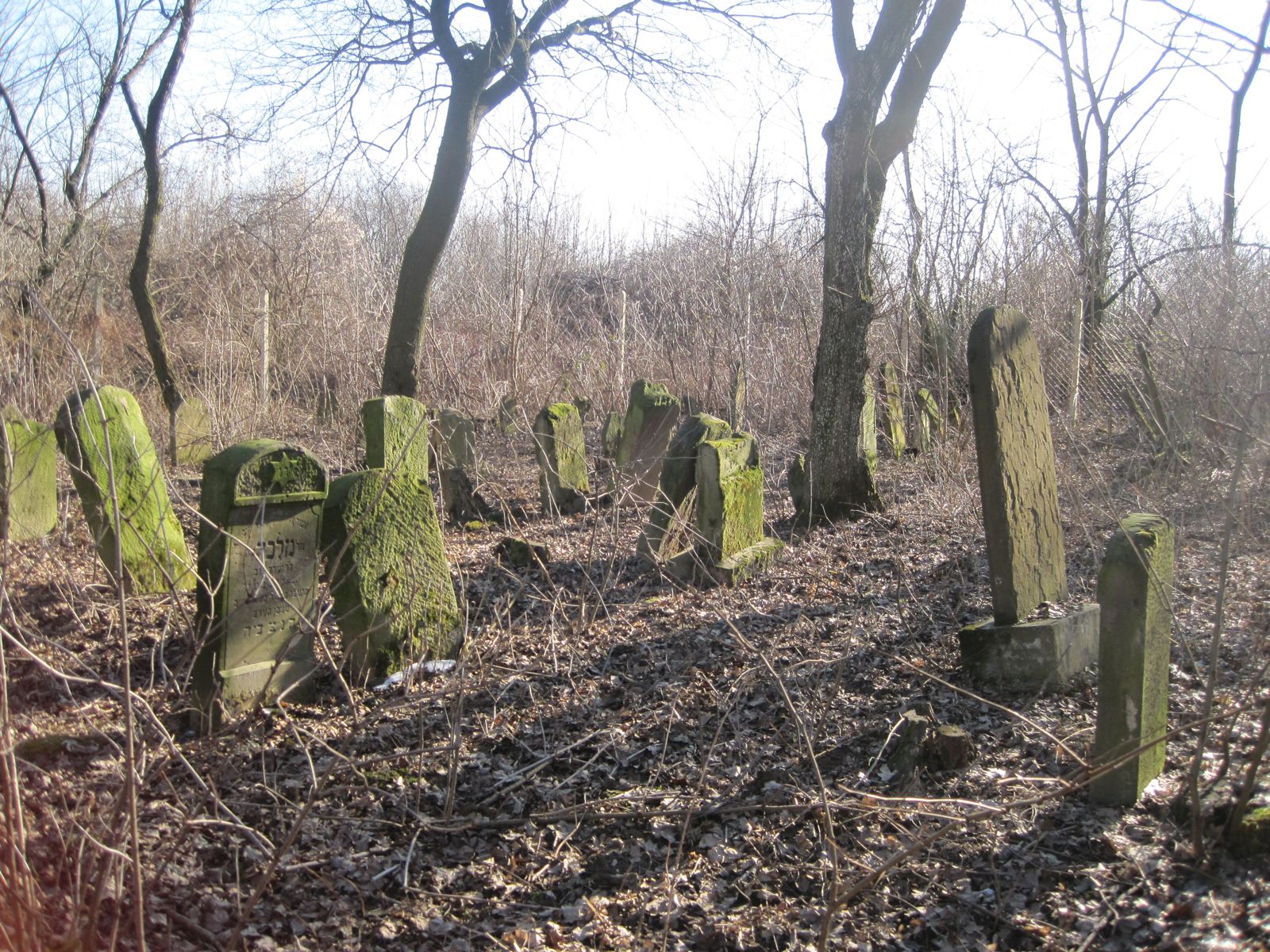
Stranany Cemetery, Michalovce, Slovakia, March 2011

My alarm goes off most mornings around 5:30am. I hear the familiar vibration, followed by a paradoxical “sing songy” instrument that I think is meant to be soothing. I immediately hit snooze and then proceed to do the same thing 10 minutes later, and sometimes 10 minutes after that, and so on. I know research says this is not a healthy way to start the day. According to headspace, “We add to our stress by starting our morning in a fight with our alarms, where we eventually concede defeat.” It’s a bad habit and I find myself often spending the next 20 minutes or so repeating mantras in my head in an effort to convince myself that everything is okay…That I am okay. That I am strong and brave and wise. These are also the same affirmations I tell my daughter most nights, hoping to instill what has often been hard for me to accept for myself.

What is anxiety really? It is distinguished by the American Psychological Association (APA) from fear, which is considered an “appropriate” response to “a clearly identifiable and specific threat.” Despite this distinction, I think it’s still fair to say that fear is at the root of most anxiety and that anxiety plays out in all of us to some degree. While society has made tremendous progress in terms of normalizing anxiety and other mental health conditions, it still doesn’t welcome these emotions at the proverbial “table.” It’s still taboo, for example, to talk about anxiety and depression at the lunch table, with your supervisor or at your child’s parent-teacher conference. And therefore, too many people suffer alone.

I’ve been in and out of therapy to treat anxiety for over half of my life. This is hard to admit and yet, I think important to normalize. And I know today’s youth are struggling at even younger ages. The impact of the COVID-19 pandemic on youth, for example, has only exacerbated an already horrific downward trend.

With the international climate aflame with strife and violence, I’ve been spending a lot more time thinking about Epigenetics, intergenerational trauma and their impact on mental health.  The idea that environmental factors or traumatic events can affect your genes and the way “your body reads and responds to your DNA” is hard to wrap your head around. And yet, I’m seeing it unpacked more and more, not just through a scientific lens, but within the arts, spiritual spaces and even counseling settings.

Now working for a Jewish organization whose mission is to fight hate and antisemitism, I’ve been spending a lot more time thinking about my own family lineage. While I’m sure my anxiety can be attributed to multiple factors, both environmental and genetic, I do wonder if my nervous system is responding, not just to perceived threats in my own life, but to those real threats that my ancestors battled with and against for centuries. How long have ancestors from within all of our communities been fighting off threats such as hate and bigotry and how does this dynamic play out in our bodies today?  I wanted to know more. And so, I turned to literature.

I recently finished the novel, The Many Daughters of Afong Moy, by Jamie Ford, and am struck by how the role of Epigenetics is being explored through historical fiction as well. An Asian-American author, Ford unpacks the role of inherited trauma through the female lineage of Afong Moy, the first Chinese woman to set foot in the US in 1834. Ford beautifully weaves together stories of Moy’s descendants, including a nurse in China serving with the Flying Tigers in WWII, a young girl quarantined during an epidemic of bubanic plague in San Francisco in 1900 and Washington’s former poet laureate, Dorothy Moy, who is raising a daughter and fighting for her mental health in 2045. In pursuing an experimental treatment designed to mitigate inherited trauma, Dorothy Moy intimately connects with past generations of women in her family tree. While the novel weaves in elements of mysticism and science fiction, it is beautiful and heart-wrenching and feels very, very real.

When I was living overseas in France in 2010-2011 in my late 20’s, I decided to take advantage of my proximity to Eastern Europe and explore first hand where my family emigrated from and why they might have left. I am the first person in my family (that I’m aware of) to have taken the pilgrimage back to the tiny town in what is now Eastern Slovakia where my family lived, before emigrating to the United States in the 1880’s. Thanks to Wikipedia and the stories passed down from my grandfather with whom I was extremely close, I know that my great-great Uncle, late Rabbi Joseph Hertz was born in Rebrín/Rebrény, Hungary in 1872. This town is presently part of the village of Zemplínska Široká in Slovakia. Hertz emigrated to New York City in 1884 a year or two after his older brother, Emmanuel (my great Grandfather) and their father, Simon came looking for better opportunities, in the face of rising antisemitism at home.

Joseph went on to become the first graduate of the Jewish Theological Seminary of America in 1894 and would go on to serve as a Rabbi in New York and South Africa. He served his final post as the Chief Rabbi of Great Britain and the Commonwealth from 1913 through two world wars and until his death in 1946.

Every few years I go back and re-read aspects of his story and discover something I didn’t know before. In my latest reading, I learned that in 1920-1921 Rabbi Hertz was the first chief rabbi to undertake a “pastoral tour” of the British empire. His pilgrimage would take him over 40,000 miles and to over 40 Jewish communities around the world, including in South Africa, Zimbabwe, Australia, New Zealand, Fiji and Canada. Just reading this is a reminder that the Jewish diaspora is wide and nuanced, built upon waves of complexity and layers of history, going back to biblical times.

My own personal pilgrimage to the village of Zemplínska Široká in the spring of 2011 took me to a small town that was completely wiped of its Jewish population at the turn of the century. To get there, I took a 10 hour night train from Prague to Košice, a bus from Košice to Michalovce and another smaller bus from Michalovce to Zemplínska Široká. I had arranged beforehand to meet a local historian in Michalovce who was kind enough to drive me to an old, overgrown and abandoned Jewish cemetery outside of town. I wanted to see if I could find the grave of my great aunt’s grandparents who were believed to be buried in that town (hence the photos above and below). While I didn’t find their specific tombstones I did find one with the same family name I was searching for (Friedman). It was remarkable to be that close to my own family story and yet to know so little about what they went through to pave the way for my family light years away.

And here I am in 2023, raising a family of my own in Middletown, CT.  As I write these words I question if I am struggling with some existential desire to answer an unspoken cry from my ancestors. What am I in search of that they never found? What inherited trauma has been passed down to me that I must embody and then let pass through me, so that it doesn’t get passed down the family line even further. 

How does inherited trauma continue to play out in our own bodies and become experienced as anxiety?

I’m not sure where this search will lead, but I know that I must take a pastoral tour of my own, to understand why and from where our pangs of unworthiness, fear and anxiety stem. I know I am not alone. And I know that the answer lies in 1000 different places.

When I wake up tomorrow though, and find myself at battle with my snooze button, I will try and be just a little kinder to myself and lean into the strengths passed down from generations of ancestors who were likely all just trying to do the same.

לְדוֹר וָדוֹר, l’dor vador, “from generation to generation”

An ancient concept in Judaic scripture generally interpreted to mean that we have a responsibility to pass on teachings from one generation to the next.

A Poem for my Fellow Humans

“In the End, we will remember not the words of our enemies, but the silence of our friends.”

Martin Luther King, Jr
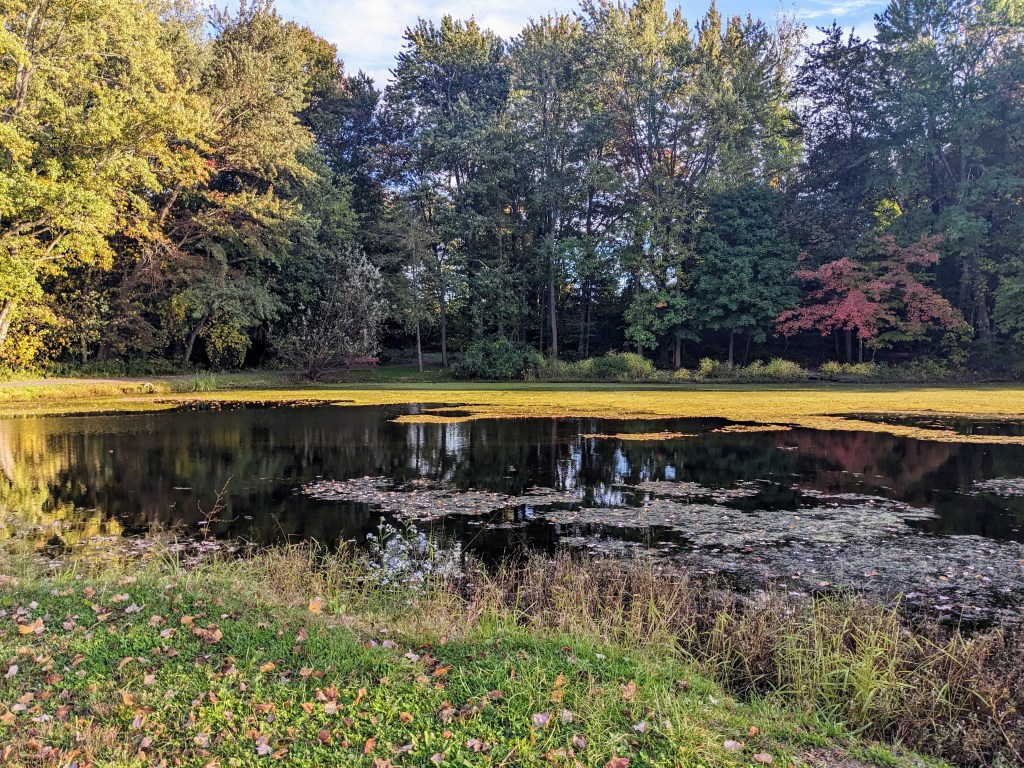
Wolcott Park, West Hartford, CT

I am thousands of miles away and I feel your pain. Your aching. Your cries. The shame. The deafening silence of the world community as you were pulled from your beds, from your homes, last Shabbat and brutally hunted down, literally and figuratively.

I cannot watch the videos. I am living them inside my body. The stories. The sounds. The smells. I am trying to feel them. To bear witness in my own small way.

I am waking up in cold sweats, imagining images of ISIS style torture and beheadings and picturing my child or her friends as victims. The agony. The fear. The insanity.

In my lifetime I have not truly felt the pain of being a Jew until now. Of being hated so deeply that you could become nothing overnight. I’ve been teased, I’ve been mocked and I’ve been laughed at. But I’ve not felt the pain of a massacre in my bedroom. My home. My town. My Synagogue. My most precious spaces.

As bomb threats in the US reverberate online… “you all need to die. If you die, I’ll be happy.” Likely a child who wrote this. A child who has learned to hate. Hate that starts at home. With the jokes and the taunts and the jeers. How young do they start to feel this? Our children. Our babies. How young is a child who feels hate towards a people they do not know. Towards a human who could have been their friend.

What has the world become? That we could feel so desperate, to not just take a life, but to savagely dehumanize a life into mere ashes, in front of their family. Where do we go from here?

A friend sent a quote to me this morning, “the Giants of our past have taught us how to be brave. Jewish persecution is as old as time, but Jewish valor is eternal.”

Shabbat shalom, my friends. May we not rest completely until humanity is restored and our children are safe.

Letting Go

“Healing may not be so much about getting better, as about letting go of everything that isn’t you- all of the expectations, all of the beliefs- and becoming who you are.

Rachel Naomi Remen, M.D.

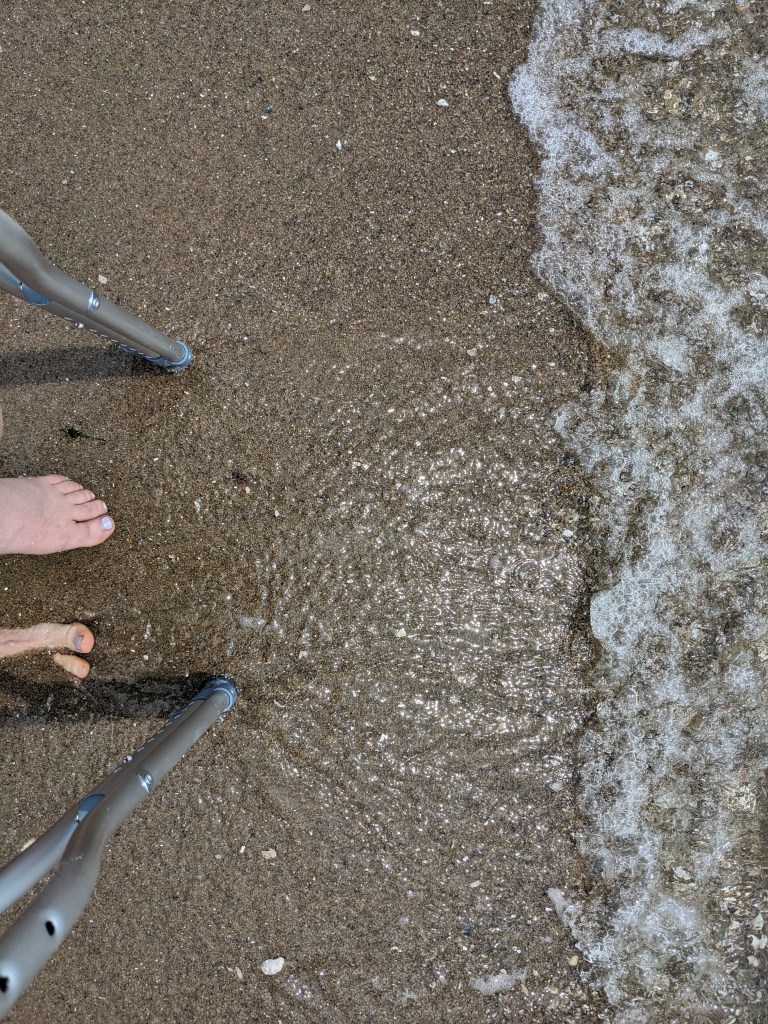
Sometimes the best thing we can do in life is to take our hands off the steering wheel and let someone else drive. There is a Yiddish expression, “Der Mensch Tracht, Un Gott Lacht,” which translates to “man plans and God laughs.” I have received a lesson in this wisdom over the last month. Less than two weeks before starting my new job, I had an absurd, freak accident which left me with a fractured ankle and what felt like an impossible situation to maneuver. Instead of planning my commute to work, I was planning a pathway to surgery and renegotiating a start date to allow for recovery. Life stopped. And the millions of little things that one moment had been in my control and seemed so important were suddenly whisked away.

Since surgery to repair my ankle, I’ve had to relearn how to go up and down the stairs. My daughter is now getting a kick out of me descending and ascending on my butt like she used to do when learning to become mobile. We are both learning to put on socks and step into shorts together. It is not straightforward. I can empathize with how tired she gets when trying to do it by herself and just wanting to give up and ask for help. Well, now we can help each other.

There have been countless lessons in this “pause” that have inconveniently inserted themselves into my life. I don’t even know where to start. For one, resisting reality or grasping for something different makes everything harder. When the Physician Assistant (PA) in the ER came in to tell me about the results of the x-ray, I was in disbelief. I started rattling off all the things I had planned for the summer and asking if I could still do them. I had plans to take my sister to NYC the next day for her 40th birthday…could we still take the train? Could I still participate in the sprint triathlon I signed up for in August? I had finally found the time to get my bike tuned up after years of it collecting dust in our garage. The PA looked at me funny and said, “well if you want to show up on the day of the race and see how you do, go for it.” (Instead my training of late has consisted of doing light ankle stretches and circles). Okay, so what about this concert or this trip or this baseball game or this adventure, etc? I immediately looked at what I was losing. Perhaps this is fair. There is a lot of loss. Not to mention, money and time and the incredible burden this places on my loved ones to pick up the slack.

But what of the gain? What do I gain from a setback?

In the last month my mind and body have slowed down, literally and figuratively. I’m not able to think much beyond what is right in front of me. At any moment I need to know where my crutches are, what I need to grab in order to sit down, whether it’s time to ice or elevate, etc. I’ve been forced to slow down in a way I didn’t think was possible, and life has not imploded. It’s gotten a bit more confusing and there are additional puzzle pieces we need to maneuver but I’m able to keep up at a pace that feels more realistic.

So what happens in a couple weeks when I can start bearing weight again, when I can commute into work or go for a walk to the mailbox? Yes even getting the mail is a formidable challenge now. Will I start piling things back on slowly, until I can’t catch my breath? Truthfully, I probably will at first. But perhaps this time I’ll connect with the ease of keeping things a bit simpler. After all, it’s not what I’m accomplishing or checking off that dictates my worth, but instead it’s in the “letting go” that I stand to gain the most. Blessings for a smooth week ahead and may you embrace the bumps and cracks along the way.

Meditation on Change

“Open the window of your mind. Allow the fresh air, new lights and new truths to enter.”

Amit Ray

Aging is a funny thing. It happens constantly. In every moment. While we are awake and while we are sleeping. Most of these moments just pass by, unnoticed. It is a natural and inevitable part of life and yet we often fight it. Or at least I fight it.

The gray hairs that start to slip through, harder to hide. Wrinkles on my face. An increase in aches and pains when I don’t work out as much. Or when I do work out. I’m growing older. Most of us don’t have too many outlets to make sense of this process. Instead we buy our way into stopping the aging process. Try this beauty service. Use this jade roller. Meditate more. Eat lighter foods. All of these recommendations on their own are perfectly reasonable and ones we could likely benefit from, but taken together, they feel overwhelming and at times counterproductive.

Our six year old Portuguese water dog, Halligan (aka Hal), was recently diagnosed with aggressive liver cancer. He was given a prognosis of about 1-2 months, if we pursue treatment. And if we don’t pursue treatment then we are looking at weeks or even days. Of course no one can say for sure and the research is spotty but either way you look at it, we have very little time left with him.

How on earth do you process something like this? One moment he’s seemingly healthy, running 2 miles in the woods with us and the next we are talking about comfort measures and how we want to talk to our toddler about mortality. (Tips on this are welcome by the way.)

As I remain hyper vigilant to Hal’s symptoms, I notice that so many of my waking hours are spent in a state of subtle scanning. I think I’m channeling my ancestors and looking for a fire to put out or a threat from neighboring tribes. I’m almost always in problem-solving mode, planning out my week ahead or doing the math on how I’m going to get to my new job on time while “lightly” guiding my daughter through her morning routine. (She’s rounding 3 years old and the concept of “threenager” feels apt.)

As I prepare to return to work full time, I’m asking myself, how did this happen again? I took the last year a half to step back and find a sense of calm and balance from the the frenzied pace I had been moving at. And, yet, if I’m being brutally honest with myself, I think I’ve recalibrated bit by bit so that I’m still following the same patterns just a little less intensely. All of these behaviors I’m sure are adaptive and in place to protect me from unseen threats. However, they are still getting in the way of me being in the here and now.

In this next phase, as I return to work, I want to reflect on what I’ve learned since “Taking a Pause” 20 months ago. In no particular order…

  • Our relationships are sacred. Our partners, our children, our parents, our colleagues, our neighbors, our friends…They are primary and deserve to be elevated above all else. No work stress or drama or inconsequential, petty argument is worth jeopardizing the connections we’ve built with those around us.
  • Parenting is hard. Full stop. Give myself grace as the journey continues to unfold.
  • When I feel cynical, which I do often, try to reframe or consider a new perspective. How am I learning, growing, and stretching through this hard thing? What is another way to look at this moment?
  • Dream. Imagine. Rest. Allow myself space for rest and creativity. Having just finished Tricia Hersey’s, Rest Is Resistance: A Manifesto, I’m moved and saddened by how consumed many of us are by “grind culture.” The oppressive nature that white supremacy and capitalism have on us is dripping in plain sight and yet we can’t see it because we’re too busy grinding away. It’s in our blood and our social makeup, but it doesn’t have to be our fate. We can resist.
  • It’s okay to not have it all figured out. Multiple times throughout the past year and a half I thought about making major career and life changes. I researched schools, ministries, organizations, yoga teacher training programs, etc. I shadowed, I prayed, I asked for answers.

And…now….I find myself returning to something very familiar, to an organization for which I worked previously. I think my search and quest for change has ironically (or not so ironically) brought me back to where I started so many years ago when I first moved up to CT.

Perhaps though, while I have come full circle in some ways, I have changed in the process. I have grown and surely aged (as is evident by my greys). And hopefully I’ve garnered a little more wisdom about what matters.

In this next chapter for myself and for all of us, may we go easy on ourselves and others. May we see the world for all its beauty and all its pain. May we stop for snuggles and cuddles and belly rubs and know the sky will not fall if we don’t send that last email. Perfectionism is dangerous and a form of violence and is perhaps the biggest threat of all to this messy and sacred process of living.

Sending love and blessings for whatever small or big steps lie ahead.

Can We Go Back?

“We are powerful because we have survived.”

Audre Lorde

It’s the spring of 2003. I’m a second semester senior at the University of Pennsylvania. I have maybe 4 weeks left before graduation and I decide now is the moment I’m ready to walk into my college’s LGBTQ+ Center. I had finally started to acknowledge my queer identity to a few close friends and was ready for a fresh start post-graduation. I was still applying for jobs and internships and wasn’t yet sure where I would land, but decided to make an appointment with the LGBT Center Director to get some advice on transitioning to life outside of Penn as a queer person.

Back then, being out as a college student was still daunting (and for many, it still is). I had essentially spent my entire college experience in the closet. It was easier to skim the surface of my social life as just a part of myself, exploring crushes and relationships with boys, but not going near my feelings for girls. I think part of me truly believed that if I pushed these feelings back far enough that they would go away. I thought I could will a different future for myself, one that placed me squarely into the range of “normal.”

It’s now 20 years later, and I’ve decided to bring my family back to campus for my 20th college reunion later this month.

I’ve lost touch with so many friends. And I have no one knocking down my door to see me again. Part of me wonders if my connections faded because of the “dual identity” I lived during my time there. I was like a fish swimming in heteronormative waters. Every once and a while, I would poke my head out and see that there were other pockets of possibility, but they felt impossible to bridge. I therefore never truly let people in to get to know me. Maybe I’m not alone in this feeling. So many of us are afraid, for different reasons, to let others in during these fraught years. And yet it’s still sad to me looking back that I was not able to open up (to myself and others) about what I was feeling and thinking and questioning as it pertained to sexuality and identity more broadly. I would likely have been met with empathy and support and realized there was a whole community of people with similar questions and life experiences.

It is largely for this reason that I feel compelled to step back onto campus 20 years later and reclaim my college experience as a queer person. I will be bringing my parents, my wife and my daughter and while I’m grateful beyond words to have them by and on my side, this pilgrimage is really a solo one.

To step back onto the Penn Quad and College Green as my full self. To walk proudly down Locust Walk and know that I’m not hiding anymore. It will surely bring up a swell of emotions, painful and joyous, but I’m prepared this time to feel them all. I will point out to my daughter the old gothic buildings where I took my first anthropology classes, the theatre world I stepped into as a college sophomore, and the tiny dorm room I lived in freshman year above the mail center in the upper Quad.

And I will walk her into the Carriage House, home to the LGBT Center, and watch her roam, free.

Here or Nowhere

“Have patience with everything that remains unsolved in your heart. Try to love the questions themselves, like locked rooms and like books written in a foreign language…Perhaps then, someday far in the future, you will gradually, without even noticing it, live your way into the answer.

Rainer Maria Rilke
Shelburne Falls, MA
Shelburne Falls, MA

I picked up a book recently from a hospital Chaplain’s library called Here or Nowhere. The Chaplain who has become a mentor to me, told me to pick any book I wanted from her bookshelf to borrow. The small dusty copy of Here or Nowhere by Renée Hermanson (1984) caught my eye. It was a simple quote on the back cover that stood out. Hermanson, writing from a Christian perspective and weaving in biblical figures to help her unpack “middle age” and all its meaning, writes, “I spent many years waiting–for time to go back to school, for the children to grow up, for our finances to get better–and then discovered time was not waiting, but marching on. I believe we need to be reminded that, as Thomas Carlyle said, our ideal is here or nowhere. We must find God in our lives and our lives in God wherever and whenever we are.”

The search for meaning and a sense of “arrival” seem to be timeless inquiries. From biblical times through the present, we are all searching, looking for answers to life’s big questions. Why are we here? What is intended for us? What is God or the world or the universe waiting for us to realize and manifest? I’ve been fighting with myself lately around these questions. I’ve been asking myself, do I want to go back to school and pursue another degree or credential? I’ve been pondering a leadership path that weaves through religion and the spiritual. I’ve also been hit with the reality that I need to focus on a new job search, to secure a full/ “fuller” time position that will give my family some more breathing room and sustenance. While just a short year ago, I thought the answer was to leave my job to find more breathing room and be home with our young daughter, now I need to reverse the cycle and work more hours. Such is the ebb and flow of life.

There is a pending fear and excitement all at the same time about the prospect of more change ahead. There is a part of me that I think will always yearn for change and new opportunities to break free from what feels like the mundane and ordinary. I’ve realized I’m chasing something that is always going to be a step (or miles) in front of me unless I change my perspective. I risk now sinking back into the “if only” syndrome of my 20’s and 30’s. If only I had a partner, if only I was settled down, if only I had a child, etc. etc. But when that elusive “if only” becomes a reality, your dreams just morph into something further away.

How can I find wisdom and answers right here in the now, without trying to search for them? How can I release the pressure to keep searching and at the same time remain a seeker and stay curious?

I recently watched the movie, Women Talking (2022), produced by Sarah Polley. It chronicles a two-day period in which women from an isolated Mennonite community grapple with the decision of whether or not to stay and fight their attackers or leave their community. It is a profound depiction of women at their strongest and weakest moments, scared out of their minds about the violence (sexual, physical, and emotional) their children might face. I was struck by the character of Ona (played by Mara Rooney) who is sometimes teased for being too lofty or imaginative in her ideals. She allows herself to dream and float above the horrors her community has endured and imagine a better world for herself and her children. She is at the same time grounded in what’s real and what’s looming if the women don’t act and make a decision. In the end, when they have every reason to give up on their faith in God, the women lean further into their faith. As one female character wisely states, they must look further out into the distance beyond what is right in front of them (in an analogy to how she steadies her horses when riding her buggy).

I also recently finished re-reading the book, The Red Tent by Anita Diamant (2007). It depicts the biblical character, Dinah who is Leah and Jacobs’s only daughter. Dinah is merely a footnote in the bible, depicted as a victim to a violent crime and sandwiched between the stories of her iconic father, Jacob and her powerful brother, Joseph. Her voice enraptures me and carries me back into Canaan and the land of my ancestors. I am struck by the lives the women lead, anchored in many ways by the “red tent” which is where they gather each month during their menstrual cycles. In the tent, they talk and dream and lament. They share their wisdom and woes and build meaning through their stories. The women are apart from the men in their community during this 3 day period each month. The men are forbidden to enter in fact. Similar to the secluded barn haystacks upon which the women sit in Women Talking (set in 2010), Dinah and her mothers gather strength from one another to go back out and face the world.

On the cusp of another spring and in honor of International Women’s Day, I am reminded that perhaps we can gather wisdom from the strong female figures of our past to make tough decisions. Can characters like Dinah and Ona who aren’t afraid to dream big in the face of incredible obstacles, inspire me to do the same? Perhaps big (and even small) decisions are not meant to be made in isolation, alone in the quiet of our minds, but instead in community with our sisters, mothers and family members of generations past. In this spirit and in the red tents of our futures, may we lean into one another’s collective wisdom to emerge stronger and refreshed for the journey ahead, knowing that here and beyond are often where the magic happens.

1 Year Later: Mindset Matters

“Perfection is the mountain that has no peak.”

Emma Norris

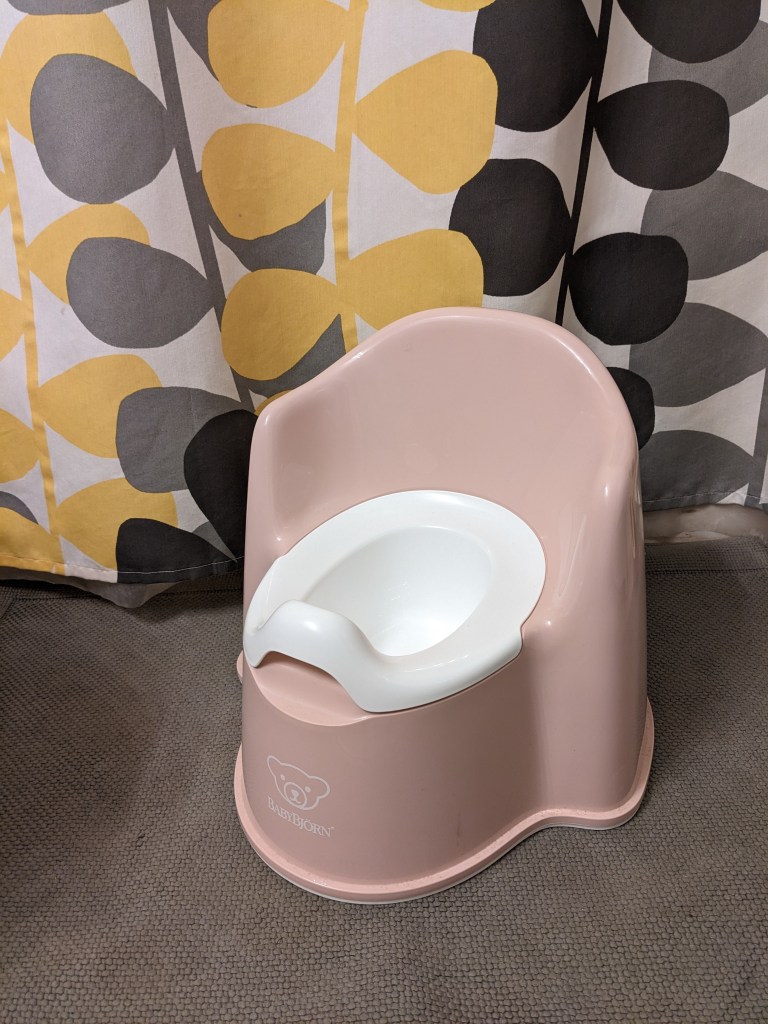
If you had told me last year I would be celebrating New Years Eve 2022 embarking on the joys of potty training I would have probably said, “that sounds like a cruel joke.”

Today we introduced our daughter to “big girl underwear.” Getting to choose among patterns including owls, mermaids, tropical fruit and trucks was a really BIG deal. In full transparency, I was dreading this process. It brings up in me all my angst around ceding control, embracing messiness (literally and figuratively) and transitions. Moreover, asking a toddler to give up a security blanket (the diaper), which is often all they have known since birth is a tall order. It’s scary and uncomfortable and not intuitive in the least. And yet, our children have to learn eventually (my older, wiser friends have promised me they won’t go to college in diapers).

As I reflect back on 2022 and what lies ahead in the new year, I continue to see my daughter and parenting as my biggest teachers. It’s been a year and counting since I started this blog. From the get go, I’ve struggled with issues of productivity and perfectionism. Through my research and writing I’ve come to see just how deep-seated these traits are in our modern culture and way of being. I touched upon this theme in one of my first blog entries, noting how tied up our sense of self-worth is with our notion of accomplishing and chasing that illusive something, whether it be a job, relationship or some idea of happiness.

Gradually, I’ve spent this last year slowing down and scaling back what is possible to produce or accomplish. Through this process I’ve recognized how habitual my “need to please” is. Whether it be through seeking validation on a parenting choice or trying to fit my life into a perfect mold of what I think it “should” look like, I continue to put increasing pressure on myself to “get it right.” Contemplating the next right move professionally, personally and spiritually consumes my thoughts most days. Making a decision about what preschool to send our daughter to next year has been like asking me to choose just one sushi roll off an entire menu. Impossible! You can’t make a perfect decision. There is no such thing and even if there was, it won’t live up to the ideal I have conjured up in my head.

At the end of the day, most of this pressure is self-imposed. We want to “do right” by our loved ones and set ourselves and them up for success. And, yet, we have to balance that idea of success with the excruciating truth that life will be hard. We will fall down, a lot. We will have “accidents” (pun intended) and there is no prescribed school or methodology that will shield us from this truth.

Perhaps then our growth comes from learning to relate differently to our pain and worries. How do we respond and react when things get hard and there is no template for how to move forward? How do we hold compassion for ourselves in the process?

Can we begin by accepting that we don’t know all the answers, nor should we? We do not need to decipher every possible outcome and algorithm when making a decision. Instead, what would it feel like to connect with humility to the messy, tangled process of living itself?

In this New Year, may a “good day” or a “good choice” be measured not by what we’ve accomplished, but instead by how we’ve related to ourselves. Did we revel in picking out the best pattern of underwear (or socks) in the morning and then remember to laugh at our bumps and “boo boos” along the way.

To all my friends and readers, happy 2023 and happy stumbling.

Note to Myself: Reflection on Parenting

“What would it be like if I could accept life – accept this moment – exactly as it is?”

Tara Brach

Dear Momma,


This wasn’t about you or your parenting in any way. Your daughter is fine. You are learning alongside her.


You got her tickets to see Laurie Berkner perform live in Hartford, CT. Her favorite artist! You blocked off the day. You carved out precious time for your family. You agreed not to invite anyone else so this could be a true family outing. It was just her, Mommy and Ima. You made every contingency plan necessary, got everyone out the door in enough time. Checklist–snack, diapers, hands, face, teeth, shoes and socks. And managed to get another pair of pants and socks on when the first pair got wet from stepping in your dog’s water bowl.


You bought these tickets months ago and were thrilled to give this experience to her. As a gift, a memory she would never forget.


And yet, when we settle into our seats and you look around, you can tell she seems unsettled. Maybe overwhelmed? Unsure what to make of her surroundings? A baby born during the pandemic, this is possibly one of the largest crowds she’s been around.


Laurie comes dancing down the aisle with her guitar and sings a familiar tune… “When I woke up today…I shouted out Hooray!…” My eyes light up and my ears can’t believe what they are hearing. Is it really her? Live, in the flesh? Strumming her guitar 20 feet away. Unbelievable.


I glance over and see my daughter melting to the ground. Shrinking into a cocoon. Eyes glazed over, lying on the floor, attempting to do a summersault in the aisle and trying to get away. She seems somewhere else. She doesn’t know what to make of it perhaps? Looks out at Laurie a few times and tries to take it all in, but then retreats again. Too much? Tired? Hungry? Cautious? Worried? I may never know.


Maybe she is unable to express how unbelievably strange it is to see this icon live, a blink of an eye away, after only seeing her on a screen or dancing to her music on Pandora. Yes, Laurie Berkner is real. She’s a person too.


I’m so incredibly disappointed in that moment. Yet, in reflecting back, I realize that as much as much as I want my daughter to fall in love with Laurie Berkner in concert, to jump up and down to “Chipmunk at the Gas Pump,” like the other kids, that’s simply not what she is feeling today. She is being her authentic self.

Perhaps to be accepting of my own thoughts, feelings and actions is an admirable goal for myself too. To share our emotions with our children and allow them to share theirs with us. And to be validating and at peace with the “let downs” and inevitable perplexities and complexities of childhood and parenting that will come.

—–

A few weeks later, this experience helps me stay much more grounded on Halloween night when my daughter refuses(!) to put on her Halloween green dinosaur costume to go trick-or-treating. She has been talking about this costume for weeks and practically every day leading up to Halloween. And yet, when push comes to shove, she decides that she doesn’t want to wear her costume and instead prefers to walk around the neighborhood and simply ask for candy.

Yet, what starts off as another huge “wait, you have to like this” (oh, what did I do wrong?) moment ends with a renewed appreciation for my child’s intuition. We must trust them, to know what’s best for them and find ways to trust ourselves in the process too.

Ultimately, my daughter decides that instead of wearing her dinosaur costume for Halloween she is going to cart it around the whole night in her blue car. It will go trick-or-treating with her!

Thank goodness for children’s creative spirts and our ongoing practice as adults to stretch — and be true to ourselves — alongside them.